Introduction
If you’ve been hanging out on LinkedIn or Twitter lately, you might have noticed SEO folks buzzing about something called MUVERA. Some say it’s a new ranking signal. Others suspect it’s a penalty system. A few even think it’s a whole new Google update.
The truth? MUVERA isn’t a penalty at all. It stands for Multi-Vector Retrieval Algorithm, and while the name sounds intimidating, the concept is actually fascinating — especially if you care about how Google understands and ranks content.
In this guide, we’ll break down what Google MUVERA is, how it works, why it matters for search quality, and what it means for SEO professionals and website owners.
What is Google MUVERA?
MUVERA is short for Multi-Vector Retrieval Algorithm — a way for Google’s search engine to find information more accurately by using multiple vectors instead of relying on a single one.
Before we dive deeper, let’s clear up one thing: this is not an entirely new idea. Search engines have always been built around information retrieval — the process of pulling relevant documents from an index when you search for something.
In its simplest form, information retrieval means:
- Google stores billions of web pages in its index.
- When you search for something, Google looks for matching keywords.
- It returns the pages it thinks are most relevant.
That’s the classic keyword-based search model. But as the web exploded from millions to billions and even trillions of pages, keyword search started showing its weaknesses.
Why Keyword Search Alone Wasn’t Enough
In the early days of SEO, keyword matching was the main game. You could take any web page, stuff it with unrelated keywords, and often still get it to rank. This is why keyword stuffing was such a common black-hat tactic.
But keyword search had two big problems:
- It was slow for huge datasets. Searching every document for exact keyword matches took time.
- It was easily manipulated. You could trick the system by adding keywords, even if the page wasn’t truly relevant.
To solve these issues, Google and other search engines moved toward vector-based information retrieval.
Understanding Vectors in Search
In the context of search, a vector is just a way of turning information — like a word, a sentence, or even an entire page — into a set of numbers. These numbers represent the properties or “features” of that thing.
Think of a vector as a mathematical fingerprint.
For example, imagine we describe three people — a dentist, a soldier, and a farmer — not with words, but with numbers that capture traits like:
- Gender probability
- Medical knowledge
- Bravery
- Risk-taking ability
- Agricultural knowledge
- Explosives knowledge
A dentist might score high on medical knowledge, low on agricultural knowledge, and somewhere in between on bravery. A soldier might score extremely high on bravery and explosives knowledge, but low on dental skills. By turning each trait into a number, we can compare very different things mathematically.
That’s the magic of vectors — they let computers compare things that aren’t obviously comparable in words.
From Single-Vector to Multi-Vector Search
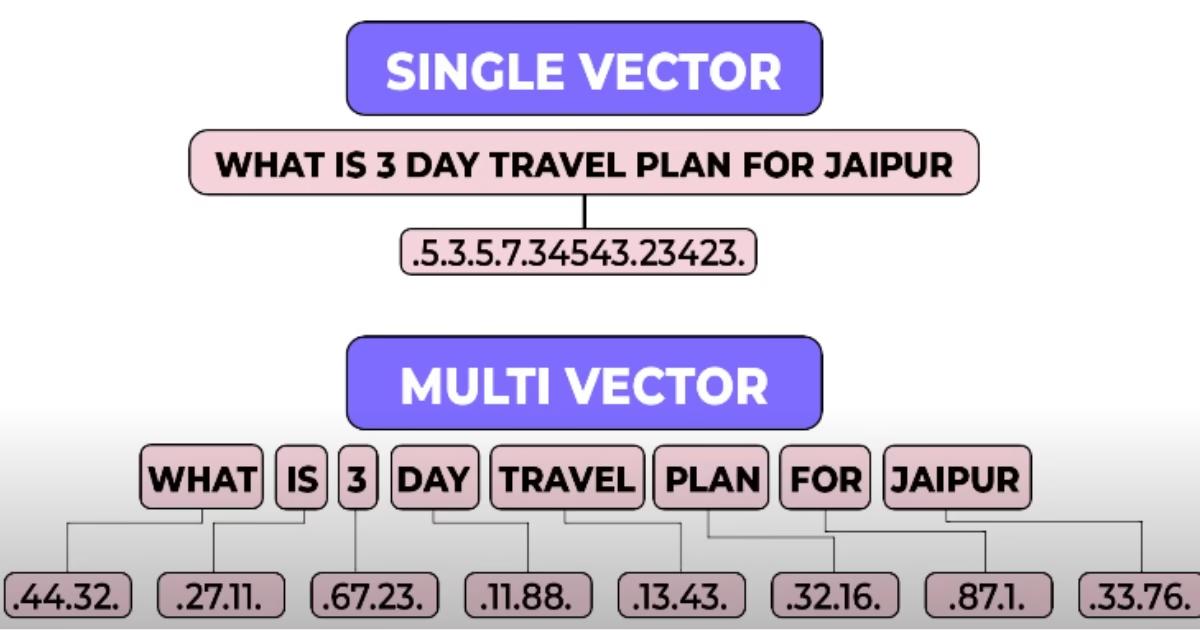
When Google processes a search query, it can do it in different ways.
Single-Vector Search
This is when the entire query is turned into one single vector. For example:
“What is a 3-day travel plan for Jaipur?”
Google converts that whole sentence into one vector, then searches for pages with a similar vector.
Pros:
- Efficient — only one vector to compare.
Cons:
- Risk of losing accuracy. Compressing a complex idea into one vector is like describing a whole person in just one word — it can’t capture everything.
Multi-Vector Search
This approach breaks the query into multiple vectors, often based on key concepts or terms. For example:
- “3-day travel plan” becomes one vector.
- “Jaipur” becomes another.
- “What is” could even be processed separately.
Google then searches using all these vectors, combining results for better relevance.
Pros:
- More accurate.
- Captures more nuance in complex queries.
Cons:
- Traditionally more computationally expensive.
How MUVERA Improves Efficiency
The clever part of Google’s MUVERA is that it gives Google the accuracy of multi-vector search without the huge cost.
Here’s the challenge:
- Searching with multiple vectors usually means more processing power and time.
- Google wants high accuracy without slowing down search results or spending exponentially more on computing.
MUVERA tackles this by efficiently merging multiple vectors into a form that can be searched almost as quickly as a single vector.
The result:
- Better relevance in search results.
- Less “junk” in SERPs (Search Engine Results Pages).
- More queries understood in context, not just keywords.
What This Means for SEO
From an SEO perspective, MUVERA doesn’t directly change ranking factors. It’s not like Google suddenly penalizes or rewards specific optimizations because of it.
However, indirectly it matters a lot:
- Pages that truly match the intent of a query will have a better chance of appearing.
- Thin or irrelevant pages that happened to match keywords will be filtered out more often.
- Long-tail queries and conversational searches will be understood more accurately.
For example:
- Old keyword-based search might treat “best apple pie recipes” and “apple orchard near me” as somewhat similar because of the word “apple.”
- With MUVERA, the vectors for these queries will be very different — one about cooking, the other about locations — reducing irrelevant matches.
Why It’s a Big Deal Beyond SEO

MUVERA isn’t just about making Google Search better for users — it’s also a technical milestone for AI systems in general.
If Google can compress complex phrases into efficient, meaningful multi-vectors, then other AI models — like large language models (LLMs) — can also:
- Provide more accurate answers.
- Work faster.
- Run at lower costs.
Lower AI processing costs could eventually mean cheaper AI tools, APIs, and services for everyone.
Real-World Example: From Theory to Search Results
Let’s imagine you search for:
“Best cafes in Paris with vegan options and free Wi-Fi”
In the old keyword world, Google might:
- Look for “cafes,” “Paris,” “vegan,” and “free Wi-Fi” in web pages.
- Return results that have all these keywords, even if they aren’t about your specific intent.
With MUVERA’s multi-vector approach, Google can:
- Understand “vegan options” as a concept, not just two words.
- Recognize that “free Wi-Fi” is an amenity filter.
- Combine these with the concept of “cafes in Paris.”
You’ll get a list of Paris cafes that actually match your requirements, not random articles about veganism or tech blogs mentioning Wi-Fi.
How to Align Your SEO Strategy with MUVERA
Even though MUVERA isn’t something you can “optimize for” directly, you can prepare your content for this new era of semantic search:
- Write for intent, not just keywords. Focus on answering the full question or problem a user has.
- Use clear, natural language. The better Google can parse your meaning, the more accurate the vector representation will be.
- Add supporting context. If your page is about a topic, include related details that might help Google’s algorithm understand its scope.
- Avoid keyword stuffing. It’s even less effective now.
Remember: in a world where Google understands meaning better, quality and relevance win over keyword tricks.
Final Thoughts
Google’s MUVERA — the Multi-Vector Retrieval Algorithm — is a behind-the-scenes upgrade that won’t show up in your Search Console as a penalty or new ranking factor. But its effect on search quality is real.
By blending the nuance of multi-vector understanding with the speed of single-vector searches, Google can deliver more relevant results, faster. For SEO professionals, this means:
- Better matching between user intent and content.
- Less noise in the SERPs.
- A stronger incentive to produce genuinely useful, well-targeted pages.
And for users? Just better answers, more often.




I am sure this pidce of witing has ouched aall the internet viewers, its really reallky gopod piece of writing
on building up new web site.